Ballistic ceramics for armour and protection
Lightweight, extremely hard ceramic armour that defeats high-velocity threats where steel is too heavy. We supply boron carbide, silicon carbide, and aluminium oxide, reaction bonded or isostatically pressed, in tiles and shaped plates to suit your platform.
What are ballistic ceramics?
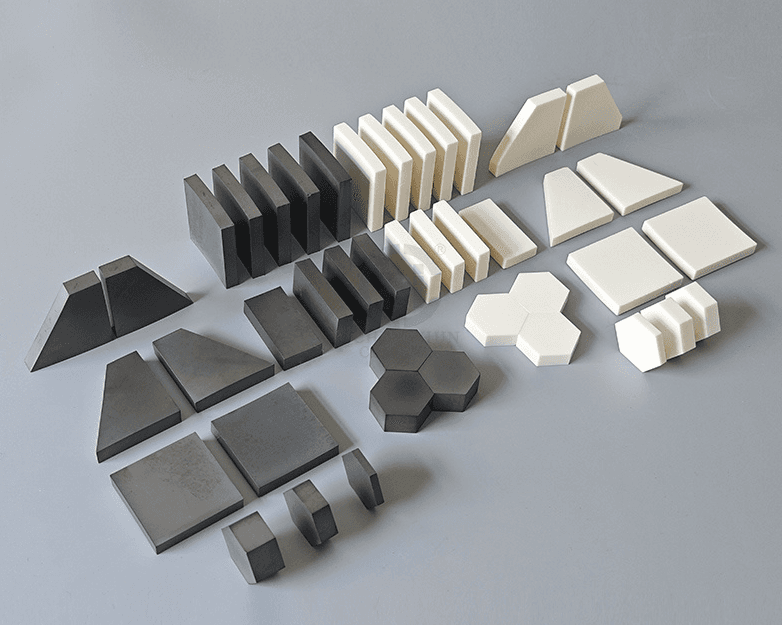
Ballistic ceramics are armour materials that shatter and erode an incoming projectile on impact, then spread the residual energy into a backing layer. The result is far more protection per kilogram than armour steel, which is why ceramics are used in body armour, vehicle armour, and aircraft.
The right material depends on the threat level and the weight budget. We work with boron carbide, silicon carbide, and aluminium oxide, and form them by reaction bonding or isostatic pressing to balance performance against cost.
Materials and forming methods
Boron Carbide (B4C)
The hardest and lightest option, for the highest threat levels and weight-critical platforms such as aircraft and dismounted soldiers.
Silicon Carbide (SiC)
An excellent balance of hardness, weight, and cost. The workhorse of modern ceramic armour.
Aluminium Oxide (Al2O3)
A proven, cost-effective armour ceramic for vehicle and structural protection where weight is less critical.
Reaction bonded
Net-shape forming that holds tight tolerances at lower cost, well suited to volume production of tiles and plates.
Isostatically pressed
Uniform pressure for high, even density and peak ballistic performance in the most demanding applications.
Where ballistic ceramics are used
Body armour
Hard armour plates for personal protection, where every gram counts.
Vehicle armour
Appliqué and structural armour for light and heavy vehicles.
Aircraft and aerospace
Weight-critical protection for rotary and fixed-wing platforms.
Critical infrastructure
Shielding for high-value fixed assets and protected positions.
Ballistic work is handled within the appropriate scope and confidentiality. Send your threat level, areal-density target, and tile geometry, and we will recommend the material and forming method that meet the spec.
Ballistic Ceramics: common questions
Which ceramic is best for ballistic armour?
What is the difference between reaction bonded and isostatically pressed?
Can you make custom tile shapes and sizes?
Related products
Silicon Carbide
Kiln muffles, tubes, liners, plates, and diamond-lapped rollers over 1000mm. Over 30 years of SiC manufacture.
Alumina Ceramics
92-99.8% pure alumina. Wear-resistant plates, tubes, and any formed shape, fired in our continuous tunnel kilns.
Technical Expertise
Replacing an underperforming part with a ceramic one? We engineer it from scratch, and guarantee the cheapest tooling.
Need ballistic ceramics?
Send a drawing, a sample, or just a description of what is failing. We will reply within 2 business days with whether we can make it, how, and at what price.